Co-authored with Sunyoung Jung.
Few numbers from the ancient world have held onto attention the way the golden ratio has. It arrives with a reputation, which is part of the problem. Before you can see why it matters, you have to push the folklore aside.
The first written reference appears in Euclid's Elements. It turns up again in later Greek and Roman writers, in the architecture they left behind, and, according to Herodotus, earlier still in Egypt. It reappears during the Renaissance in the work of figures like Leonardo da Vinci. The useful question is not who used it, but why the number is interesting in its own right.
What φ Actually Is
The golden ratio, written , is irrational. It has no exact fractional representation, and its decimal expansion never terminates or repeats. Numerically , but the digits go on.
Its defining property is almost embarrassingly simple. is the number equal to one more than its own reciprocal.
Multiply both sides by and rearrange, and you get a quadratic:
The quadratic formula gives two solutions:
Only the positive root makes sense as a ratio, so we take
That is the whole thing. The mystique of the golden ratio is anchored to a single quadratic equation. Everything else is consequence.
The geometry: dividing a line
There is another way to define , older than the algebra and, I think, more honest. Take a line segment and split it into two pieces, one longer and one shorter, so that
If we normalise the whole to length and call the longer piece , then the shorter piece has length , and the condition becomes
Cross-multiplying gives , and the positive solution is , which is . The line is in the golden ratio precisely when the whole-to-larger ratio equals the larger-to-smaller ratio. That "ratio of ratios" is what gives the number its name.
φ and the Fibonacci sequence
The Fibonacci sequence starts with and then sums the previous two terms:
The ratio of two consecutive Fibonacci numbers is already close to :
The further along the sequence you go, the tighter the approximation. This is not a coincidence. If as , dividing the Fibonacci recurrence by gives
Taking :
which is exactly the defining equation of . The Fibonacci ratios converge to because, in the limit, they satisfy 's defining recurrence.
φ and the Great Pyramid of Giza
The most striking claim about in the historical record concerns the Great Pyramid. According to Herodotus, the pyramid was built so that the area of each triangular face equals the area of the square whose side is the pyramid's height.
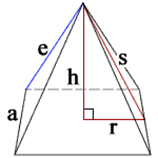
Let be the height, the slant height of a triangular face, and the side length of the square base. The face-area-equals-square condition gives:
Pythagoras applied to the right triangle formed by , , and gives:
Substituting:
Dividing through by :
Letting , this becomes , which is exactly the defining quadratic of . The positive root is
The measured values for the Great Pyramid are , , . Computing the ratio:
That is within of .
Whether this was deliberate or a happy coincidence is a live historical question. The measurements are approximate, and there are reasonable arguments on both sides. What is not in question is the mathematics. If you enforce the face-equals-square condition, falls out exactly, not as a near miss. The pyramid's proportions either obey that rule or they do not, and they obey it closely enough that honest people can disagree about why.
Why any of this matters
It is easy to over-romanticise , and a lot of popular writing does. Strip that away and what remains is genuinely worth knowing. A single quadratic equation whose positive root turns up in a line division, in the limit of a recursive sequence, and possibly in the proportions of a structure built five thousand years ago. The recurrence is not mystical. It is what happens when the same simple constraint keeps arriving in different clothing. That is usually what "unreasonable effectiveness" looks like up close.
References
- Omotehinwa, T. O. and Ramon, S. O. (2013). Fibonacci Numbers and Golden Ratio in Mathematics and Science. International Journal of Computer and Information Technology, issue 4.
- Markowsky, G. (1992). Misconceptions about the Golden Ratio. The College Mathematics Journal, issue 1.
- Meisner, G. Phi, Pi and the Great Pyramid of Egypt at Giza. goldennumber.net.
- Weisstein, E. W. (2003). Irrational Number. MathWorld.